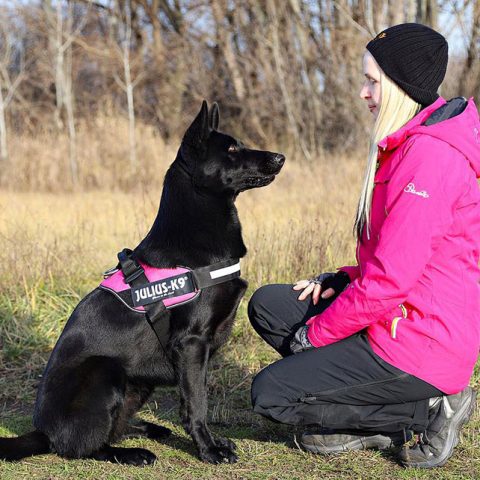
German Shepherds are a very easy breed to train, and if trained properly, you can get the best out of them.
Mostly German Shepherds are known for their intelligence and strength, because of which they are taken as police and military dogs.
If a German Shepherd grows up with good training, they can become well-behaved dogs. Training is the answer if you want your German Shepherds to be good boys.
Training is the best way to manage the dogs, especially when talking about German Shepherds, who can be very aggressive at times.
Proper training and guidance are needed to handle German Shepherds.
So, let’s discover the perfect age to start training your German Shepherd, importance of training GSDs and how you should train them according to their age. This is a complete German Shepherd training guide to get your dog the perfect training.
What is obedience training?
At times, German Shepherds can be out of control. They tend to bark a lot and get extremely excited. To control them, obedience training is very important.
Obedience training will guide them in behaving in public places and with other dogs and strangers. Some might develop behavioural issues, and obedience training will prevent or adjust their maladaptive behaviour.
Training will also teach them skills, which is also a great way of bonding with your German Shepherd.
German Shepherds are very smart, and it is not difficult to train them. They start the training at a very young age.
Obedience training will teach them the dos and don’ts, but it is also a good way to keep them active. It is a good way of using their energy.
There are various ways and techniques of obedience training. Some owners like to use tools, treats, and reinforcements.
The obedience training can be given at home by following some guides, but some people like to go for professionals.
It can be easily done at home when it comes to basic training.
Dos and don’ts of obedience training
Before starting the home training, there are some dos and don’ts you need to know and keep in mind as a German Shepherd owner;
- You have to be extra patient and calm when training German Shepherds as they are very energetic and barely patient; they can eat up all your energy but do not give up.
- Get a strong leash as you have to make them practice walking with a leash, and when we are talking about German Shepherds, they are indeed very strong, and you may not want to end up hurting your shoulders, so better get yourself a good quality leash.
- Always reward them whenever they accomplish a task or learn a new skill and behave obediently; it will defiantly motivate them to perform better.
- Set timing or schedule so that it is not foreign for them.
- Do not just take them for training anytime that is out of their schedule; it will not help them but only confuse them.
- Start with basic commands like “sit,” “come,” and “no.”
- Always praise your dog for keeping them motivated.
- Do not give them hard punishments; it can affect their mental health, and they might start getting scared of you.
- Don’t overwork your dog and exceed the time.
- Be consistent, and don’t break the flow.
Essential and basic German Shepherd training commands
Training commands fall under two categories Basic Obedience Commands and Advanced Obedience Commands.
Basic Obedience Commands:
Basic obedience commands should start at a very young age. It is the beginning phrase. German Shepherds can master these commands over 3 to 4 sessions.
- Attention: always try to keep your dog’s attention on you.
- Here: whenever you command your dog, they should be in front of you.
- Heel: make them understand that they have to walk beside you.
- Sit: they need to sit whenever they are asked to.
- Stay: they should stay beside you when you are in a public place.
- Down: they should get down whenever given food.
- Come: they should come to you whenever you call them.
- Stand: they need to understand that they need to stand up if they are sated on hearing this command.
- Go out: in this command, they should leave the place.
- They need to go inside their crate or a room upon hearing this command.
- Let go: letting go of any object.
- Crate: they should know that this is the command to go inside the crate.
- Good: this command should be used to praise them.
- Good dog: another command for praising.
- No: it should be used to stop them from doing something.
- Don’t do that: this command is similar to “no.”
- Ok: represents the agreement of the owner.
- Eat your food: command for eating.
- Stand still: is usually used for leash training.
- Leave it: to stop them from picking up an object.
Advanced commands training:
- Fetch: teach them how to fetch a ball or any other object.
- Jump: jumping over to fetch objects.
- Track: teach them to track and find hidden objects.
- Guard: teach them to guard their owner.
- Bite: they should be able to bite objects on command.
- Bark: barking when in danger.
- Quite: should stop barking when told to.
Tips for training German Shepherds commands
Disciplining your German Shepherd is very important, but the process can be tricky. It can either make or destroy the relationship between you and your dog. So be careful of the ways you will use to train them.
Some dos and don’ts are already mentioned for you to keep in mind while training German Shepherds, but here are some tips you can use to train your loved ones:
- Reward positive behavior with a treat and praise.
- Try to distract them when they are committing bad behavior.
- Use small time outs while in between training.
- Refrain yourself from yelling or giving physical punishments.
- Prevent unwanted behaviors and replace them with expectable behavior.
- Use your voice to train them; a higher voice to praise them. A firm voice for commands, a louder voice for danger. And a stern voice for disappointment.
Steps for training a German Shepherd
Training your German Shepherd‘s commands is not a difficult task. A few items are needed to ensure your success in the training. Patience and consistency are required to bring transition to your dog. Below are some methods that will help you to train your dog.
The First Command Method
Choose your words – Make a list of German Shepherd Commands you want to teach your dog. This method works best for dogs who are not yet introduced to any of the commands. Keep the list where it can be easily accessible.
The First Command – Start teaching basic commands like ‘sit.’ To make them follow the command, lure them with treats. Take their favorite treat in your hand and move it over his head to lure him into a sitting position. As he sits, give him the treats and repeat the process until your dog understands the command.
Keep Practicing – Keep in mind that the training should be consistent and requires patience. People around working with your dog, make sure they use the same command. Continue practicing and do not stop because irregular practice can hamper teaching them commands.
Move to the next – Once your German Shepherd has mastered the previous command, gradually move to the next command, such as down or stay. Teach these skills with any method.
Take it outside – When your dog is reacting to your commands, take him outside, test him with more distractions, and practice the commands. When he obeys, reward him with treats and praises. That way, he will be encouraged to accept commands.
Five basic commands you can teach your German Shepherd the command ‘come.’
Step 1 – Always start this training indoors. Wait until he plays with his toys and then call out his name. When he responds to you by looking, show him his favorite treat and use that treat to lure your dog by saying the command, ‘come.’
Step 2 – Shower him with praises and give him his treat when he comes. This is the best way he will learn the positive association of responding to your commands.
Step 3 – When he is not following the command, gently tug on his leash and repeat the word ‘come’ while showing him his treat. You need not be harsh on your dog when he does not come willingly but rather deal with patience and gentleness. Try with different treats until he can respond to your command, and give him a treat whenever he responds positively.
Step 4 – After training your dog indoors, take your dog outdoors to train and repeat the same process as you have done indoors.
Step 5 – Keep escalating the training by increasing the distance between you and your dog and repeating the exercise until he can understand the command ‘come’ without the need for a treat.
How to train a German Shepherd to not pull on a Leash
No fancy gadgets are required for this training guide, and the things required are a trusted collar, treats, clicker or whistle (if desired). Below are some methods to train them not to pull on a leash.
The Passive Method
Choose the route – It is important to choose and consider where you plan to walk. It is best to choose a familiar place for your dog. A place new to your dog might distract him easily or get them excited.
Especially with German Shepherds who have a nose similar to a hound and that quintessential desire to chase and herd that all shepherds have. The walk intends to teach restrain, eventually alleviating their tugging.
A place away from busy streets and with an openness that will allow for uninterrupted walking would be best for your dog.
Set the Tone – Make your dog sit calmly before going for a walk, and while adjusting his collar, speak to him in a relaxed tone.
It helps ‘set the Tone for the kind of walk you will have and shows them they won’t be rewarded with a walk without exercising a cool little collection of their own.
Be the Leader – The passive method’ will help the dog understand that you are the one in control of where and how you enjoy the walk. If he tries to pull away, do not pull back on the leash, but stop moving until your dog realizes it can’t go further.
Reward their Attention – Your dog should realize after a few moments of restraining that they can’t move any further without you moving them and when they come to you begging to go further, reward them with praise or treats.
Be consistent – After consistent practice, he will gradually understand that pulling on their leash does the opposite of what they want and eventually stops. At this point, you may opt to reward your dog by moving in the direction they had intended after you gain their Attention and mild composure.
How to Train a German Shepherd to Heel
There are several effective techniques to stamp out any pulling behavior, and training will consist of asserting your control while on walks.
Read: How to train a German Shepherd to heel
The Stop and Heel Method
Before heading out, quietly secure him to his leash so that he won’t get worked up. Once he gets excited, it will be hard to control. Once secured, head out for your walk as you normally would.
‘Heel’ – Whenever he tries to walk ahead or begins to pull, issue a firm ‘heel’ command. Any words can be used, whichever is preferable for this command; make sure you give it only once, and you want him to respond to your instructions the first time, every time.
Stop – Be firm and stand still when you give the command. Eventually, he will have to stop and probably turn and look up at you, confused. Wait patiently for him to come to your side. It may take time for him to understand, but he will quickly catch on.
Reward – Give him a treat as soon as he returns to your side and begins walking again. You can also praise him and make sure he returns to the same side each time.
Consistency – It is important to react the same way every time he tries to pull away. Anyone working with the dog should follow the same steps until he stops pulling altogether.
Why is training important for German Shepherds?
German Shepherds are very intelligent, and they can learn every skill and task if taught properly, because of which they are taken as police and military dogs.
They are physically fit and might have some skin and stomach issues, but it is not that serious. They love to exercise, and they are prone to dysplasia and bone problems because training is important for them. It keeps them healthy.
German Shepherds can adapt to new situations and the environment without much problem, and proper training will enhance this behavior. German Shepherds are very active. Sometimes, it is very difficult for the owner to keep up with them, so training helps them utilize their energy.
German Shepherds are very loyal to their owners and can be good protectors. They can be very friendly and pleasant if taught properly. Because of their wild nature, they might attack strangers, so to prevent such behavior, training is important.
Excessive barking and chewing are one of their natures. It should be controlled with the help of training. Training also builds confidence and strength in German Shepherds.
Training is also a part of mental stimulation, which they need very much. It develops a greater bond between the dog and the owner.
What happens if you don’t train your German Shepherd?
- If you don’t train your German Shepherd, they might be stubborn and don’t listen to the owner anymore.
- They might misbehave in public, and there is a higher chance they might attack strangers.
- They might develop a habit of barking excessively.
- They might keep jumping on people, which can be embarrassing at times.
- They might end up chewing your furniture and carpet and other household stuff.
- They will not understand that they need to go outside to potty and might do it inside the house.
- They will not know when to play and when to rest; they will not follow any schedule.
Are German Shepherds easy to train?
Yes, German Shepherds are mostly easy to train because of their obedient nature. They are aggressive, impulsive, and wild at times, but that does not mean they are bad dogs or are not obedient enough.
They need a little bit of behaviour modification which can be easily done with the help of obedience training and behaviour training.
With proper training, we can get the best out of them. They perform well in tasks and listen obediently to commands.
Normally the training starts when they are still young, making it easier to teach them. If the training starts late, then there can be a possibility of them having problems adapting to the training process, but it is not that serious; it will only take a bit longer than usual.
The perfect age to start training a German Shepherd
The perfect time for German Shepherds to start training is when they are young or puppies. That time is best to shape them. Usually, German Shepherds start their training when they are 8 weeks old. During this stage, they learn fast, and it is easy to manage them.
They are less rebellious and wild, making it easy for the owner. If the training starts early, then there are higher chances of the dogs learning the task fast.
The training is kept basic during this time, so they are not confused about the commands. Sometimes if the adaptation is done late, then there are possibilities that the training will start late. In that case, the training process will slow down as the dog is already has developed the behavior and habits, and it will be a bit difficult to mold them all again, but it is not impossible.
Benefits of obedience training
- German Shepherds with proper training can protect you from danger.
- Training will lead to a strong bond between both of you.
- There is a higher chance for them to join the military or police with proper training.
- They will better understand you and know when they are supposed to play and when they need to stay quiet.
- They will know how to walk alongside their owner.
- They will have a proper understanding of potty training and where they need to potty.
- Obedience training will prohibit them from picking any stuff and putting it in their mouth, which they love to do, leading to health issues.
German Shepherd training guide according to their age
| Age | Training goals |
| 8-16 weeks (2-3 min in the morning, afternoon and evening ) | Socialization– Puppies have critical socialization, which is very difficult to correct if it’s too late; hence the socialization training should start at a very young age. Create training– Crate training is very important. It’s similar to having a house of their own. It keeps them safe and keeps you tension free when you are leaving them alone in the house. Crate training helps the owner have free time or do the house chores in peace; German Shepherds need to learn to stay in the crate during feeding and sleep. Housetraining– Housetraining is very easy to learn. Crate training and house training are somewhat similar. |
| 3-9 months (3-5 min in the morning, afternoon and evening) | Obedience training- Start teaching them some basic commands such as “no,” “stop,” “come,” and “good” leash training also comes under obedience training. Recall- Teach them to respond to your call as soon as they hear it. They need to know when you are calling them. Impulse control– If it is not being controlled, it can turn into maladaptive behavior hence teaching them to control their impulses. |
| 9-24 months (5-10 min in the morning, afternoon and evening) | Advanced training- Fetching, jumping, smelling, and finding items come under advanced training. Hunting, protecting- German Shepherds are a wild breed. They should know how to hunt for their safety, and their main job is to protect their owner. |
7 Tools for training German Shepherds
Leash and collar
At 3-9 months of age, German Shepherd dogs should be trained in house habits and obedience and recall impulse control. They are very energetic, and if not trained properly, they can chase practically everything. Thus, to teach the limits of his self-control, a dog collar and leash can be effective.
Collars are great tools for socializing training. A training collar comes with sensors that detect pulling, excessive barking, aggressiveness, or undesirable antics. Stimuli-like vibrations, sounds, and tiny shocks are remotely generated and act as automatic deterrents for your dog to stop what they are doing.
Puller Training Rings
Puller training rings consist of 2 rings included in various athletic training routines: jumping, fetching, and tug-of-war sessions of higher intensity for all such activities. Since it’s lightweight, you can handle this set of rings with ease, even if the session is physically intense.
These are some of the many ways that you can employ to train:
Running: First, throw rings one by one. Allow your German Shepherd dog to retrieve one ring, then show him the other ring and throw it. Repeat the exercise, and it trains a dog to retrieve items, which helps him develop speed and agility.
Jumping: When you throw the rings, and your dog catches one of them, give the other one instead. Your German Shepherd dog should release the first ring and jump after the second. This exercise is useful to train his attention and reaction skills.
Pulling: Hold the rings in your hands and let your German Shepherd tug at them. Once in a while, he let go of the rings to boost his morale. Use two rings at a time to train him to give back an item. It helps to improve his strength and stamina.
Swimming: The rings float in water, so you can combine all other activities and replicate them in water for break-in-monotony. This exercise trains all muscle groups and acts as a therapeutic break from hot, sweaty regimens.
HDP 18-Ft Dog Training Tunnel
Since they are known for their energy and agility, intense training is required, such as a dog training tunnel kit. It is made up of a high-density polymer (plastic) material with a collapsible wireframe that’s easy to set up and store. This setup is a classic essential for agility training your German Shepherd.
The tunnel can be expanded since the wireframe is flexible and collapsible. Gradually extend its length and modify the orientation from straight to a curved tunnel that will test its limits. You can keep his favorite treat ready on the other end to avoid anxiety when he emerges from the other end.
Behavioral Training Clicker
Clicker training is good positive reinforcement training. It can help command your German Shepherd to sit, walk, stop barking, stay, or correct poor behavior.
Dog whistle
Communicating with your dog can be difficult, especially if you do not know the language to reach out to him. An optimal auditory range of a German Shepherd dog is 45,000 Hz to 65,000 Hz. This is way above the human auditory frequency range of 18,000 Hz. This capacity may be impaired with age and other health-related issues.
The shrill, high-pitch sound produced by a dog whistle is 35,000 Hz, which is inaudible to the human ear but very much audible to your dog. This can be useful to your German Shepherd dog to stop doing an activity that the trainer does not ask.
Nero Ball Classic K9 Ball on a Rope
If you want to give your dog a tempting toy to entice him to jump, tug or chase, this natural rubber ball on nylon rope is the tool.
The bright color pops out to your German Shepherd, making for a good game of hiding and seeking. Tie it up at a height, and give it a slight oscillation. This is enough to invite your dog to jump at it. Adjust the height gradually to improve his leap.
Flyer Durable Flying disc
This is a great toy to nurture his aerial skills and seek hidden items. This is also floatable in water, so it can help you exercise your dog’s legs in the water’s resistance.
Although tennis balls and sticks are good for fetching and throwing catches, frisbees are fun because of the dual advantage of longer flying range and the time in-air.
Why did German Shepherds become stubborn, and how to identify it?
German Shepherds tend to be stubborn most of the time, and it is a major problem for German Shepherd owners.
They will not listen to the owners and bark excessively, chew things, jump on people, and bite them, and all these can be very frustrating for the owners.
Dealing with them becomes very difficult as it is the test of patience. The owners need to understand what is causing this and try to solve it.
Why they become stubborn:
- German Shepherds are very intelligent, and at times it can cause problems as they might think they are not treated properly.
- They are very independent and do not want to be controlled.
- If the dog is adopted at a very late age, it will be difficult to deal with them and teach them discipline as they have already built their characteristics.
- They are very protective of their owners, and they can be a little difficult to handle in the public environment.
- German Shepherds need clear rules. If they do not understand the commands, they might become aggressive.
- If they are mistreated, then they might become stubborn.
- If you do not have a strong bond with your German Shepherd, they might not listen to you.
How to identify this behavior.
It is not too difficult to identify these behaviors. You can tell that they are stubborn when they do not listen to your commands, disobey you, misbehave, do not cooperate, bark too much even after commanding them not to, will chew the household stuff, behave aggressively toward strangers.
How to Handle Stubborn German Shepherd?
- Adopt positive reinforcement strategies
- Make the most of your daily walks
- Take Advantage of Fun Games and Play
- Choose your training area carefully
- Avoid distractions
- Make training your everyday lifestyle
Why bonding is important before starting the training?
Having good relations and strong bonding can help you train your dog more easily and go even faster. Bonding activities create a dog that is a joy to have and gives both of you confidence.
How to bond with German Shepherds?
- Play with them
- Training
- Learning your dog’s language
- Praising them
- Treats
Conclusion
German Shepherd dogs are intelligent and smart dogs that easily learn simple tricks. They are also energetic and known for their physical body structure. They love to please their owners and would make a great companion for family members.
There is plenty to learn about owning and living with such intelligent working breed dogs. They need a lot of care and regular training to keep them healthy and happy. A trained German Shepherd is an impressive sight that could do anything they teach.